
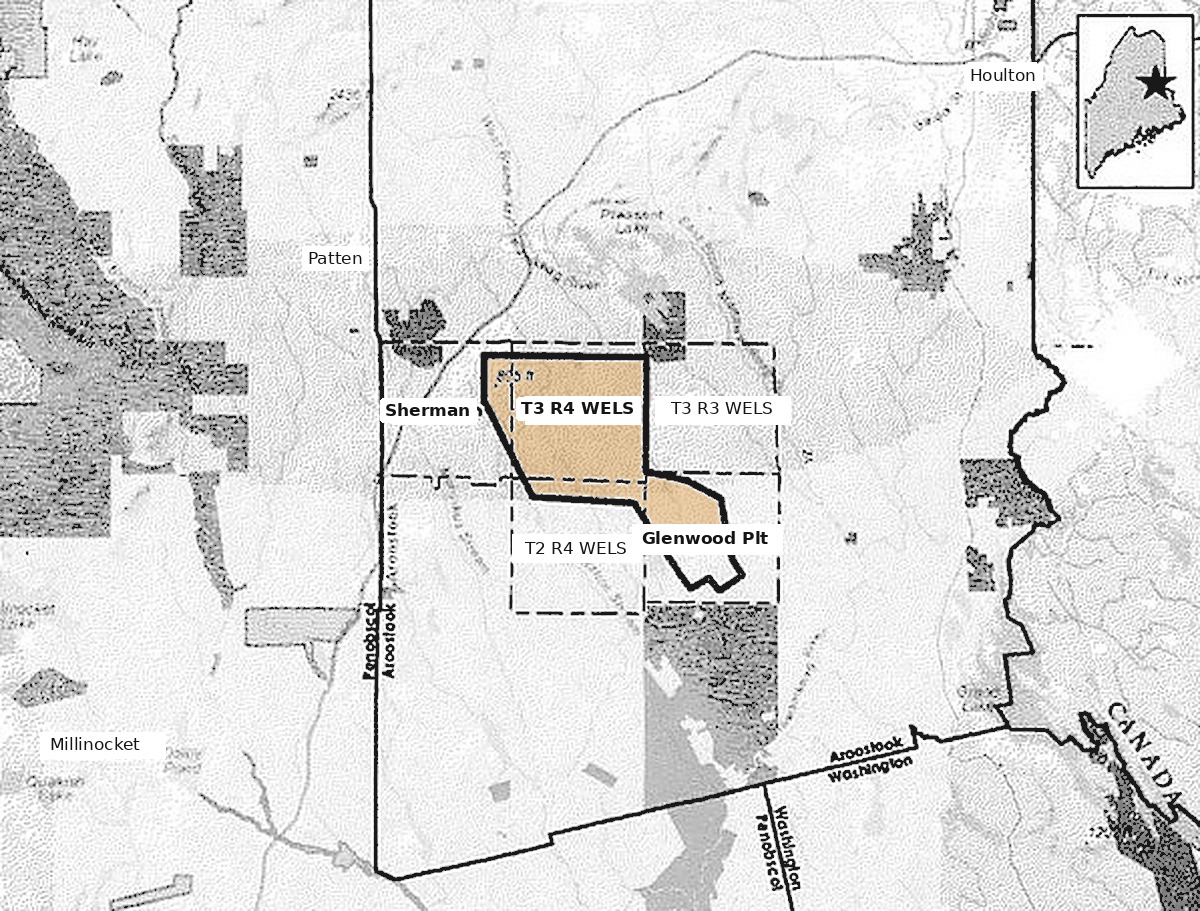
On October 27, Aroostook County officials and state legislators met with Clearway, the developer of an 800-megawatt wind project proposed for Sherman, Glenwood Plantation and the unorganized townships of T3R4 WELS and T2R4 WELS. Preserve Rural Maine attended.
Officials and legislators had plenty of questions, and many of them didn’t get clear answers.
The project at a glance
- Size: 800 MW, awarded by the Maine PUC in late summer
- Buyers: Power is contracted to Maine, Rhode Island, and Vermont
- Location: Sherman, Glenwood Plantation, T3R4 WELS, and T2R4 WELS
- Land: About 50,000 acres leased
- Timeline: Studies, design, and at least a year of state Site Law review; construction not expected before late 2030 or early 2031
- Turbines: Model not yet chosen
- Contract: 20-year fixed price; power purchase agreement expected by the end of this year
- Decommissioning: Bond set at 100%, re-estimated every five years
- Jobs: 2,500 claimed, including transmission construction
Clearway said it isn’t asking for anything yet. Listening sessions and information sessions will come first, followed by the public meetings the state requires.
The savings estimate
The PUC estimated more than $400 million in net ratepayer savings over the 20-year contract. Two attendees asked how that figure can be relied on when the contract isn’t final. Clearway said the bid price can’t change. When asked whether the contract terms would be made public, Clearway said it didn’t know and that the question would have to go to the PUC.
Clearway says the savings come from wind producing the most power in winter, when natural gas is tight and prices spike. That claim doesn’t line up with ISO New England’s own planning. In June, ISO lowered its assumption for onshore wind at winter peak from 65% to 10% of capacity after reviewing a larger set of cold-weather data (Transmission Planning Technical Guide, Rev. 8.5; ISO presentation, May 2026).
The savings are also calculated for the ISO New England grid. Northern Maine isn’t part of that grid. It connects to New Brunswick.
We believe residents should be able to see the contract and the assumptions behind the savings estimate before they’re asked to accept a project on the strength of it.
Will any power stay in Aroostook?
Clearway said it is exploring whether some power could serve northern Maine. When PRM questioned them later in the meeting, Clearway was clear that this is not a promise. It hasn’t confirmed that the infrastructure exists, which would require an interconnection study with EMEC or Versant, and it hasn’t looked at whether it would be allowed to sell power here. Since the full 800 MW is already contracted to other states (including Maine, but not for Aroostook County), any power for Aroostook would mean building more than the PUC approved.
Until there’s an actual plan, power for Aroostook shouldn’t be counted as a benefit of this project.
Questions about jobs, land, and decommissioning
Jobs. The 2,500 figure includes transmission construction. Clearway hasn’t said how many jobs will remain after construction or how many will go to Maine workers.
Land. Clearway has stated the project would be sited on 50,000 acres of leased land. They also say 1 to 2 percent of the leased land will be used. When transmission was proposed for this project in the past, the developer’s land impact figure counted only pole foundations. Residents should ask what is included in Clearway’s number: turbine pads, roads, clearing, collector lines, and the collector substation.
Decommissioning. Clearway plans a 100% bond, re-estimated every five years. But if a developer or later owner goes bankrupt, recovering that money can be difficult. Landowners and taxpayers could be left with the cost.
Community benefits, TIFs, and legal costs
Preserve Rural Maine raised a concern that applies to every energy project in the state: community benefit payments are reduced by state funding formulas. For example, a town offered $500,000 may net only $200,000 to $300,000.
PRM also asked Clearway to cover legal and administrative costs for the county and communities as they evaluate benefit packages. Clearway agreed.
In the unorganized territory, the county would negotiate any TIF. Maine counties have done this before for wind projects, including Franklin, Hancock, Washington, Somerset, and Penobscot. A TIF can also return a share of the tax revenue to the developer, so it isn’t automatically a benefit to residents. In Franklin County’s Kibby wind project, a state tax official said unorganized territory taxpayers would have paid less without one. Anyone weighing a TIF should know who comes out ahead before agreeing to it.
How to stay involved
Clearway has agreed to meet regularly with the county group and keep a running FAQ. We’ll share those materials here as they become available.
The upcoming listening sessions and information sessions are the best chance to get questions answered on the record. If you live in or near Glenwood Plantation, Sherman, or the surrounding area, we encourage you to attend. If you have questions or concerns about this project, please contact us.
Leave a Reply